
The round-profile branch of the urchin bait craze
Spiky ball baits.
Odd shape. Serious bass tool.
“Spiky ball” is the plain-English name anglers are increasingly using for the round urchin-style bait: a compact center body surrounded by flexible arms. The profile looks strange on the deck, but in the water it gives anglers an unusual mix of presence, slow movement and 360-degree motion.
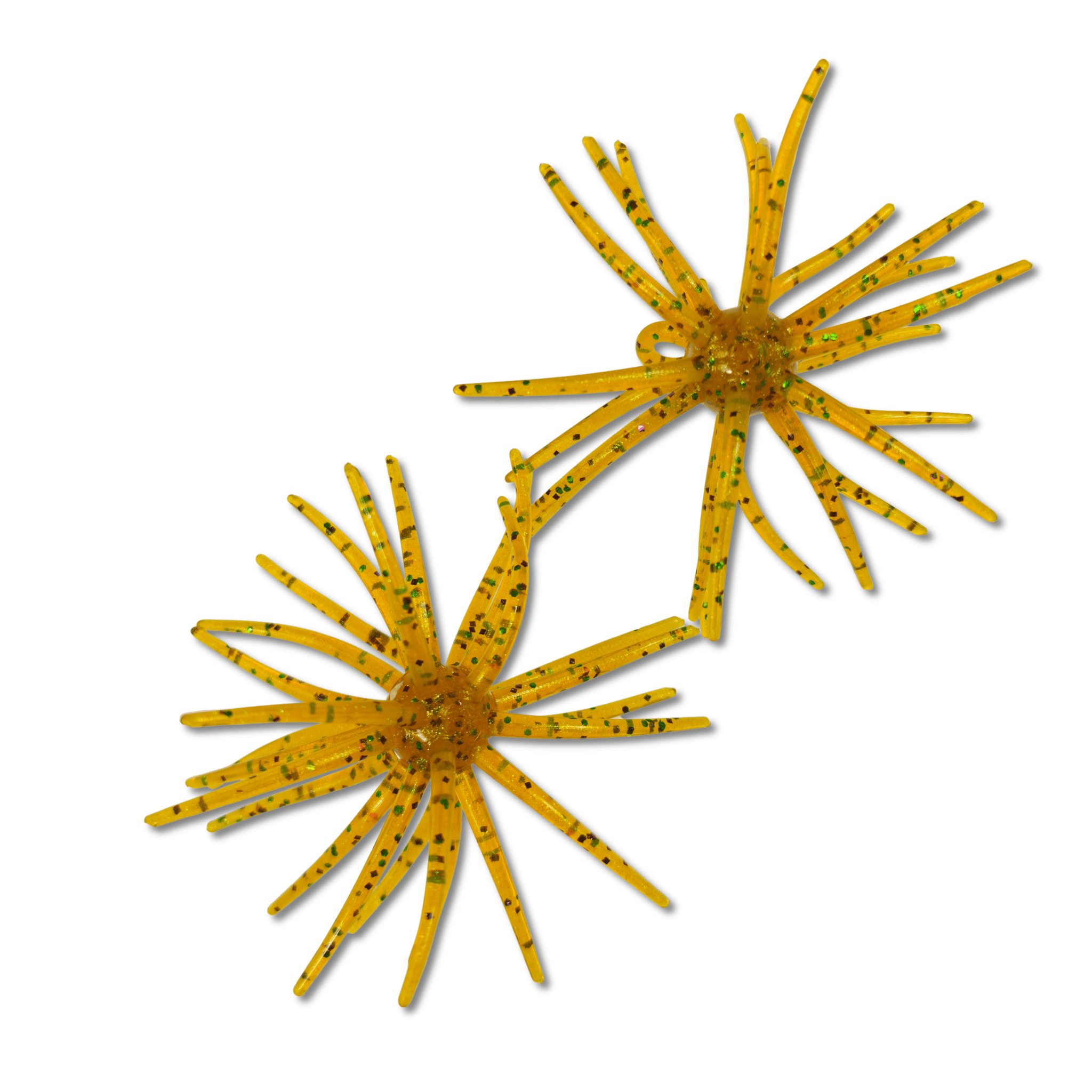
A useful name for the round version.
Bassmaster described the 2026 category as having two recognizable branches: soft-plastic dice baits with skirt material, and the round “urchin” or “spiky ball.” That distinction is useful because the round bait behaves differently than a cube simply because of its body shape, arm layout and rigging options.
Round center
The center holds the hook and often the added weight. Body size matters because it controls how much plastic the hook must clear and how compact the bait really is.
Movement in every direction
The flexible arms pulse, flare and catch water when the bait falls, hovers or rests. The bait does not need a hard retrieve to keep moving.
Rigging changes the whole bait
Internal weight, nail weight, hook style and line angle can make the same spiky ball hover, glide, fall head-first or work near bottom.
The profile is new. The fishing decisions are familiar.
The current craze is tied especially closely to pressured and suspended bass, but the underlying questions are normal fishing questions: How deep are the fish? How fast should the bait fall? How much movement should the angler add? How exposed can the hook be around the cover?
Suspended / open-water work
Full-size round urchins can be rigged to hang or fall slowly in the water column. Current tournament coverage repeatedly emphasizes pauses, fall rate and keeping the bait in front of suspended fish.
Cover / bottom-oriented work
The same family can also be fished on drop shots, free rigs and other finesse systems. Smaller or more compact versions make more sense when the job shifts from open-water target to defined cover or bottom contact.
Three decisions before you cast.
You can ignore most of the hype if you answer these three questions first.
Where are the fish?
Suspended in open water, following bait, tight to a dock, on rock, or relating to bottom? Depth and cover determine how much weight and hook exposure you can get away with.
How fast should it fall?
Fall rate changes the presentation dramatically. Current pro coverage repeatedly stresses adding only enough weight to reach the target while preserving the slow, lively posture.
Does the hook clear?
A hook can look large beside the bait and still be too small once the body compresses around it. Test actual clearance, not just hook-number conventions.
Spiky ball, urchin, fuzzy dice, Coike — what are we actually talking about?
The language is messy because the category grew faster than the vocabulary. We use spiky ball for the round urchin-style branch. “Urchin” is the broader generic category word. “Fuzzy dice” usually points toward the cube/dice branch. “Coike” is a HIDEUP product-family name, not the generic name for every bait in the category.
Built from current fishing coverage, not invented terminology.
We use current tournament, industry and technique coverage to keep the guide aligned with how anglers are actually talking about and fishing these baits.
Current urchin/spiky-ball terminology and multiple rigging approaches.Bassmaster — Ball of fuzz / dice bait
Useful distinction between dice-style and round urchin/spiky-ball categories.Major League Fishing — Urchin craze
Modern tournament context and pro technique development.Field & Stream — How to fish an urchin bait
Recent full-size rigging and fall-rate coverage.
Know the profile. Then choose the bait.
SpikyBallBaits.com is an informational guide. When you are ready to compare actual sizes and makers, Qwik Fishing maintains a dedicated Urchin Baits category.